

Ephesians 2:8 – 9 (The Message)
Saving is all his idea, and all his work. All we do is trust him enough to let him do it. It’s God’s gift from start to finish!
As I wrote on Tuesday, Jesus was sent into the world to save it—and to save you. As humans, we are flawed individuals who often struggle to overcome our own limitations. The evil present in this world has influenced us, turning us into selfish and self-centered beings, which is far from what we were created to be. In truth, we were created in the image of God, and that image is love. There are moments when each of us discovers our true, loving selves. Yet, there are also times when we fail to live up to the purpose for which we were created, falling short of embodying God’s love.
It is the grace of God that makes our salvation possible. God willingly sacrificed His only child for you, and because of this, He forgives your failures. God’s ultimate desire is for you to learn to love as He loves, guiding you toward the hope, peace, and joy for which you were created. So, continue to work toward the perfect love in which you were created, striving for perfection. At the same time, accept God’s grace in your shortcomings, trusting that as you pursue this perfect love, forgiveness and growth are always available.

John 3:17
For God did not send his Son into the world to condemn the world, but to save the world through him.
John 3:17 reminds us that Jesus did not enter the world to condemn, but rather to save. This fundamental truth shaped his entire ministry, as he consistently revealed the path to salvation. Jesus demonstrated through his teachings and actions that we are called to care for one another, echoing the notion of being our brother’s keeper—a responsibility Cain once questioned. Instead of distancing ourselves from others, we are invited to embrace the call to look out for and support those around us.
Jesus’s purpose was not to frighten us with the threat of hell, but to lovingly welcome us into paradise. His life was a continual invitation to begin a journey marked by peace, hope, and joy. Jesus frequently proclaimed that the kingdom of God is at hand, emphasizing that we have a choice—he longed for everyone to choose salvation. By following his example, we can start living in God’s kingdom now, experiencing the transformation he offers.

James 1:19 – 20
My dear brothers and sisters, take note of this: Everyone should be quick to listen, slow to speak and slow to become angry, because human anger does not produce the righteousness that God desires.
If we truly applied the wisdom of James, we would begin by making a conscious effort to listen carefully and attentively. Too often, during conversations or discussions, our focus shifts toward preparing our own responses rather than genuinely hearing what the other person is expressing. This tendency becomes even more pronounced when we are passionate about the topic at hand, leading us to prioritize our own viewpoints over understanding others.
However, to love as God commands, we are called to practice active listening. This involves not only hearing the words spoken by others but also striving to understand their perspectives—the experiences and feelings that shape their point of view. By doing so, we cultivate empathy, allowing ourselves to connect with others on a deeper level and appreciate their unique circumstances.
When we invite God’s Spirit to guide our interactions, we are empowered to shift from destructive patterns of communication to constructive dialogue. Even if disagreements remain unresolved, we play a vital role in ensuring that situations do not escalate or worsen. As followers of Christ, our calling is to be peacemakers—those who bridge gaps and foster understanding.
Achieving this requires us to listen with love and respect for everyone, embodying the example set by Jesus. Through compassionate listening, we can create spaces of peace, healing, and connection, fulfilling our calling to reflect God’s love in our relationships with others.

Ephesians 4:31 – 32
31 Get rid of all bitterness, rage and anger, brawling and slander, along with every form of malice. 32 Be kind and compassionate to one another, forgiving each other, just as in Christ God forgave you.
Paul’s words to the church in Ephesus offer a message that every Christian needs to embrace. If we truly put his instructions into practice, we would become living examples of God’s light in a world often marked by darkness and bitterness.
We are called to be kind, compassionate, and forgiving—just as God has extended kindness and forgiveness to us. Our role is not to respond to the world’s brokenness with anger or bitterness. Instead, we are to be sources of hope, demonstrating that change is possible. By allowing God’s love and grace to shine through us, we can bring light to those who are struggling and help point the way toward a better future.

1 Corinthians 12:4 – 6
4 There are different kinds of gifts, but the same Spirit distributes them. 5 There are different kinds of service, but the same Lord. 6 There are different kinds of working, but in all of them and in everyone it is the same God at work.
Each of us has been blessed with unique talents and abilities. This diversity is intentional—God designed us all differently, with a specific purpose in mind for every individual. Our deepest satisfaction comes when we discover and live out that purpose, engaging in the life of service that our loving Creator has called us to. As we embrace this calling and contribute to the well-being of others, we are rewarded with a sense of peace that only comes from fulfilling God’s plan for us.
The ways in which we use our gifts are directed by God. Even when the path forward is unclear, we are invited to trust that God will guide us and reveal where and how our talents can best be used. Faith is essential as we walk this journey, confident that God’s direction will lead us to where we are meant to serve. By trusting God and appreciating the life we have been given, we recognize that each day is a blessing, and our unique gifts are opportunities to make a meaningful difference.

1 Peter 4:8-10
Above all, love each other deeply, because love covers over a multitude of sins. Offer hospitality to one another without grumbling. Each of you should use whatever gift you have received to serve others, as faithful stewards of God’s grace in its various forms.
When we genuinely love others, our acts of service flow naturally from a place of joy rather than obligation or complaint. As Christians, we are called to extend love not only to our brothers and sisters in faith but also to our neighbors. Jesus makes it clear that our neighbor is not limited by proximity or familiarity—everyone is our neighbor. This means our responsibility to help others is universal, and the way we offer assistance should be shaped by the unique gifts that God has given each of us.
Sometimes, we may limit our understanding of helping others to financial support. While providing monetary aid is important and one way to serve, it is not the only means available to us. God has entrusted each of us with distinct talents and abilities, and we are called to use all these gifts for the benefit of those who are less fortunate. By sharing our talents—whether they are skills, time, encouragement, or resources—we fulfill our calling to serve God through service to others. In doing so, God will ensure that we have what we need in order to continue serving faithfully, trusting that our acts of love and service reflect God’s grace.
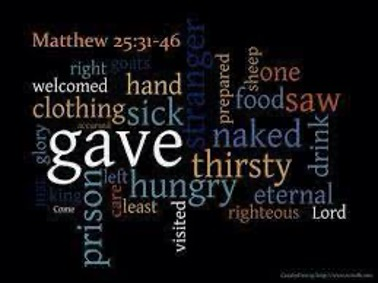
Matthew 25:35 – 40
For I was hungry and you gave me something to eat, I was thirsty and you gave me something to drink, I was a stranger and you invited me in, I needed clothes and you clothed me, I was sick and you looked after me, I was in prison and you came to visit me.’
Then the righteous will answer him, 'Lord when did we see you hungry and feed you, or thirsty and give you something to drink? When did we see you a stranger and invite you in, or needing clothes and clothe you? When did we see you sick or in prison and go to visit you?
The King will reply, 'Truly I tell you, whatever you did for one of the least of these brothers and sisters of mine, you did for me.'
Matthew 25 contains one of my favorite passages, often referred to as "The Sheep and the Goats." In this section, Jesus presents a clear message about how we are to treat those who are marginalized in society. He emphasizes that serving the needs of others is central to living out our faith.
What stands out most is that the sheep described in this parable served God by caring for others without seeking recognition or realizing they were doing anything extraordinary. Their actions were motivated not by a desire for praise, but by a genuine commitment to do what was right and necessary. This is the standard for all who profess Jesus as their master: to serve others simply because it is the calling of Christ.
Let us strive to live our lives in such a way that, when we stand before the Lord in judgement, we will be welcomed into God's presence. This invitation comes because we have served God faithfully through meeting the needs of others, embodying the spirit of Christ in our actions every day.

Genesis 1:1
In the beginning God created the heavens and the earth.
Last week, I took my first cruise, and throughout this journey, I was continually amazed by the works of God. The vastness of the ocean, the beauty of the Caribbean islands we visited and passed by, and the diversity of plant and animal life—all so different from what I encounter in my daily routine—left me in awe of the Creator. With each new experience, my appreciation for God and the breadth of His creation grew, offering me an expanded perspective of the world.
Today, I want to encourage everyone to remember that God’s creation is far larger and more intricate than what we see in our everyday lives. We must pause and recognize that God calls us to think beyond our narrow existence and to open our eyes to the fullness of His creation. Instead of limiting our understanding of God to our immediate surroundings or confining His creation to what is visible to us, let us broaden our vision to embrace the possibility that there is much more to this world.
We should open our hearts to the idea that God’s plan is more expansive and elaborate than we could ever imagine. Rather than viewing differences as something negative, let us see them as fascinating aspects of God’s creation. Change should be embraced as a new manifestation of God’s creative work—something to be enjoyed, not feared. By doing so, we honor the greatness of God and the endless possibilities found within His creation.
