
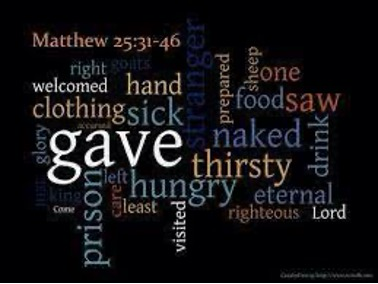
Matthew 25:35 – 40
For I was hungry and you gave me something to eat, I was thirsty and you gave me something to drink, I was a stranger and you invited me in, I needed clothes and you clothed me, I was sick and you looked after me, I was in prison and you came to visit me.’
Then the righteous will answer him, 'Lord when did we see you hungry and feed you, or thirsty and give you something to drink? When did we see you a stranger and invite you in, or needing clothes and clothe you? When did we see you sick or in prison and go to visit you?
The King will reply, 'Truly I tell you, whatever you did for one of the least of these brothers and sisters of mine, you did for me.'
Matthew 25 contains one of my favorite passages, often referred to as "The Sheep and the Goats." In this section, Jesus presents a clear message about how we are to treat those who are marginalized in society. He emphasizes that serving the needs of others is central to living out our faith.
What stands out most is that the sheep described in this parable served God by caring for others without seeking recognition or realizing they were doing anything extraordinary. Their actions were motivated not by a desire for praise, but by a genuine commitment to do what was right and necessary. This is the standard for all who profess Jesus as their master: to serve others simply because it is the calling of Christ.
Let us strive to live our lives in such a way that, when we stand before the Lord in judgement, we will be welcomed into God's presence. This invitation comes because we have served God faithfully through meeting the needs of others, embodying the spirit of Christ in our actions every day.
For I was hungry and you gave me something to eat, I was thirsty and you gave me something to drink, I was a stranger and you invited me in, I needed clothes and you clothed me, I was sick and you looked after me, I was in prison and you came to visit me.’
Then the righteous will answer him, 'Lord when did we see you hungry and feed you, or thirsty and give you something to drink? When did we see you a stranger and invite you in, or needing clothes and clothe you? When did we see you sick or in prison and go to visit you?
The King will reply, 'Truly I tell you, whatever you did for one of the least of these brothers and sisters of mine, you did for me.'
Matthew 25 contains one of my favorite passages, often referred to as "The Sheep and the Goats." In this section, Jesus presents a clear message about how we are to treat those who are marginalized in society. He emphasizes that serving the needs of others is central to living out our faith.
What stands out most is that the sheep described in this parable served God by caring for others without seeking recognition or realizing they were doing anything extraordinary. Their actions were motivated not by a desire for praise, but by a genuine commitment to do what was right and necessary. This is the standard for all who profess Jesus as their master: to serve others simply because it is the calling of Christ.
Let us strive to live our lives in such a way that, when we stand before the Lord in judgement, we will be welcomed into God's presence. This invitation comes because we have served God faithfully through meeting the needs of others, embodying the spirit of Christ in our actions every day.

Genesis 1:1
In the beginning God created the heavens and the earth.
Last week, I took my first cruise, and throughout this journey, I was continually amazed by the works of God. The vastness of the ocean, the beauty of the Caribbean islands we visited and passed by, and the diversity of plant and animal life—all so different from what I encounter in my daily routine—left me in awe of the Creator. With each new experience, my appreciation for God and the breadth of His creation grew, offering me an expanded perspective of the world.
Today, I want to encourage everyone to remember that God’s creation is far larger and more intricate than what we see in our everyday lives. We must pause and recognize that God calls us to think beyond our narrow existence and to open our eyes to the fullness of His creation. Instead of limiting our understanding of God to our immediate surroundings or confining His creation to what is visible to us, let us broaden our vision to embrace the possibility that there is much more to this world.
We should open our hearts to the idea that God’s plan is more expansive and elaborate than we could ever imagine. Rather than viewing differences as something negative, let us see them as fascinating aspects of God’s creation. Change should be embraced as a new manifestation of God’s creative work—something to be enjoyed, not feared. By doing so, we honor the greatness of God and the endless possibilities found within His creation.
In the beginning God created the heavens and the earth.
Last week, I took my first cruise, and throughout this journey, I was continually amazed by the works of God. The vastness of the ocean, the beauty of the Caribbean islands we visited and passed by, and the diversity of plant and animal life—all so different from what I encounter in my daily routine—left me in awe of the Creator. With each new experience, my appreciation for God and the breadth of His creation grew, offering me an expanded perspective of the world.
Today, I want to encourage everyone to remember that God’s creation is far larger and more intricate than what we see in our everyday lives. We must pause and recognize that God calls us to think beyond our narrow existence and to open our eyes to the fullness of His creation. Instead of limiting our understanding of God to our immediate surroundings or confining His creation to what is visible to us, let us broaden our vision to embrace the possibility that there is much more to this world.
We should open our hearts to the idea that God’s plan is more expansive and elaborate than we could ever imagine. Rather than viewing differences as something negative, let us see them as fascinating aspects of God’s creation. Change should be embraced as a new manifestation of God’s creative work—something to be enjoyed, not feared. By doing so, we honor the greatness of God and the endless possibilities found within His creation.

3 John 1:11
Dear friend, do not imitate what is evil but what is good. Anyone who does what is good is from God. Anyone who does what is evil has not seen God.
I think this scripture is very straight forward. We all have a choice. We can imitate good or evil. But today I want to take this a step further. My focus is not on what actions we decide to take, but rather on which values or causes we choose to support and identify with. As Christians, I hope that we would never choose to do evil to another. However, should we remain passive and do nothing when wrongdoing occurs, or even worse, celebrate the results of that evil.
When you study bullies there are three categories. First the bully and their allies, second the victims, and third the bystanders. The third group is the largest and therefore holds the most power. When this group chooses to not become involved, they are then passively siding with the bully. This is not what Jesus called Christians to do. On the contrary, Jesus taught that we are to be the defenders of the marginalized. When we witness injustice, hate, or fear, our Master urges us to speak up for those in need. And any that stand for the oppressed are glorifying our Lord Jesus the Christ by those actions.
Dear friend, do not imitate what is evil but what is good. Anyone who does what is good is from God. Anyone who does what is evil has not seen God.
I think this scripture is very straight forward. We all have a choice. We can imitate good or evil. But today I want to take this a step further. My focus is not on what actions we decide to take, but rather on which values or causes we choose to support and identify with. As Christians, I hope that we would never choose to do evil to another. However, should we remain passive and do nothing when wrongdoing occurs, or even worse, celebrate the results of that evil.
When you study bullies there are three categories. First the bully and their allies, second the victims, and third the bystanders. The third group is the largest and therefore holds the most power. When this group chooses to not become involved, they are then passively siding with the bully. This is not what Jesus called Christians to do. On the contrary, Jesus taught that we are to be the defenders of the marginalized. When we witness injustice, hate, or fear, our Master urges us to speak up for those in need. And any that stand for the oppressed are glorifying our Lord Jesus the Christ by those actions.

James 1:17
Every good and perfect gift is from above, coming down from the Father of the heavenly lights, who does not change like shifting shadows.
Recognizing God’s Daily Blessings
Far too often, we find ourselves focusing on what we lack rather than appreciating what we have. Modern society tends to dwell on our shortcomings and failures, overshadowing the moments of success and gratitude. This pattern of thinking can be used as a distraction, steering our attention away from the blessings that fill our lives each day.
In light of this, it is important to pause and follow the wisdom found in the old hymn: “Count your Blessings.” Every day, God provides for our needs—an act rooted in pure, unfathomable love. By taking time to reflect on the blessings we receive, and by naming them, we become more aware of the depth of God's love for each of us. This practice not only brings gratitude to the forefront but also reminds us of the constant care and provision that God offers daily.
Every good and perfect gift is from above, coming down from the Father of the heavenly lights, who does not change like shifting shadows.
Recognizing God’s Daily Blessings
Far too often, we find ourselves focusing on what we lack rather than appreciating what we have. Modern society tends to dwell on our shortcomings and failures, overshadowing the moments of success and gratitude. This pattern of thinking can be used as a distraction, steering our attention away from the blessings that fill our lives each day.
In light of this, it is important to pause and follow the wisdom found in the old hymn: “Count your Blessings.” Every day, God provides for our needs—an act rooted in pure, unfathomable love. By taking time to reflect on the blessings we receive, and by naming them, we become more aware of the depth of God's love for each of us. This practice not only brings gratitude to the forefront but also reminds us of the constant care and provision that God offers daily.
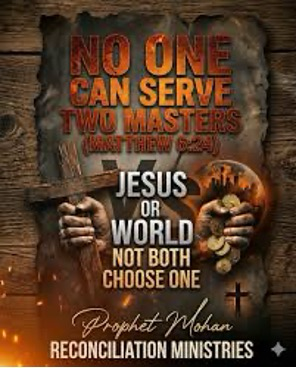
Mattthew 6:24
“No one can serve two masters. Either you will hate the one and love the other, or you will be devoted to the one and despise the other. You cannot serve both God and money.
Serving God Above All
It is crucial for every Christian to remember a fundamental truth: we cannot allow ourselves to lose sight of whom we are truly called to serve. In our modern society, countless influences compete to become the primary focus of our lives. The relentless pursuit of wealth, the desire for power, and, for many, even the daily challenge to meet basic needs, all vie for our attention. Any one of these pursuits can easily take center stage, distracting us from our highest calling—to serve God first and foremost.
Ultimately, our lives will not be measured by worldly standards but by the love for which God created us. When we live according to the world’s expectations, true peace and fulfillment remain elusive, as we are always striving for the next goal or achievement. In contrast, when we devote ourselves to serving God alone, we discover the peace that surpasses all understanding, as promised in scripture. By making God our only true master, we open ourselves to a life of serenity and purpose.
“No one can serve two masters. Either you will hate the one and love the other, or you will be devoted to the one and despise the other. You cannot serve both God and money.
Serving God Above All
It is crucial for every Christian to remember a fundamental truth: we cannot allow ourselves to lose sight of whom we are truly called to serve. In our modern society, countless influences compete to become the primary focus of our lives. The relentless pursuit of wealth, the desire for power, and, for many, even the daily challenge to meet basic needs, all vie for our attention. Any one of these pursuits can easily take center stage, distracting us from our highest calling—to serve God first and foremost.
Ultimately, our lives will not be measured by worldly standards but by the love for which God created us. When we live according to the world’s expectations, true peace and fulfillment remain elusive, as we are always striving for the next goal or achievement. In contrast, when we devote ourselves to serving God alone, we discover the peace that surpasses all understanding, as promised in scripture. By making God our only true master, we open ourselves to a life of serenity and purpose.
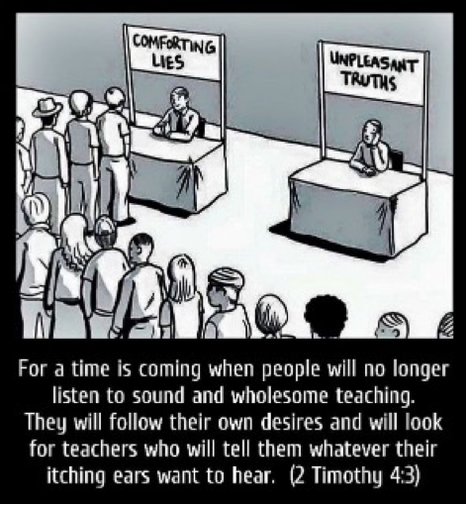
2 Timothy 4:3 – 5
You’re going to find that there will be times when people will have no stomach for solid teaching, but will fill up on spiritual junk food—catchy opinions that tickle their fancy. They’ll turn their backs on truth and chase mirages. But you—keep your eye on what you’re doing; accept the hard times along with the good; keep the Message alive; do a thorough job as God’s servant.
In our modern world, it has become increasingly common to approach scripture with the intent to confirm our own perspectives. Rather than allowing God’s Word to shape our worldview, we sometimes search the Bible for passages and seek out spiritual leaders who affirm what we already believe. When faced with scriptures that challenge us, we may be tempted to avoid or ignore those texts. This tendency is not new—it has been present throughout history. We find ourselves trying to fit God into the limitations of our own understanding, instead of striving to see the world as God intends. In doing this, we risk replacing our devotion to the Creator with a focus on worldly distractions and priorities.
To remain faithful and avoid these pitfalls, we must use the two greatest commandments as our guide: first, to love God, and second, to love our neighbor. Everything we are taught and everything we believe should be measured against these core principles.
Additionally, we are called to practice what John Wesley described as Christian (Holy) Conferencing. This involves engaging in meaningful and constructive dialogue—not only with those who share our views, but also with those who hold different perspectives. By actively listening and considering all viewpoints, we create space for the Holy Spirit to guide our understanding together.
Finally, it is important to recognize that even as we serve the same God and are led by the same Spirit, there will be times when we do not agree. In these moments, we are called to continue loving one another through our differences. By doing so, we fulfill God’s command to love, showing respect and compassion for each other even in the midst of disagreement.
You’re going to find that there will be times when people will have no stomach for solid teaching, but will fill up on spiritual junk food—catchy opinions that tickle their fancy. They’ll turn their backs on truth and chase mirages. But you—keep your eye on what you’re doing; accept the hard times along with the good; keep the Message alive; do a thorough job as God’s servant.
In our modern world, it has become increasingly common to approach scripture with the intent to confirm our own perspectives. Rather than allowing God’s Word to shape our worldview, we sometimes search the Bible for passages and seek out spiritual leaders who affirm what we already believe. When faced with scriptures that challenge us, we may be tempted to avoid or ignore those texts. This tendency is not new—it has been present throughout history. We find ourselves trying to fit God into the limitations of our own understanding, instead of striving to see the world as God intends. In doing this, we risk replacing our devotion to the Creator with a focus on worldly distractions and priorities.
To remain faithful and avoid these pitfalls, we must use the two greatest commandments as our guide: first, to love God, and second, to love our neighbor. Everything we are taught and everything we believe should be measured against these core principles.
Additionally, we are called to practice what John Wesley described as Christian (Holy) Conferencing. This involves engaging in meaningful and constructive dialogue—not only with those who share our views, but also with those who hold different perspectives. By actively listening and considering all viewpoints, we create space for the Holy Spirit to guide our understanding together.
Finally, it is important to recognize that even as we serve the same God and are led by the same Spirit, there will be times when we do not agree. In these moments, we are called to continue loving one another through our differences. By doing so, we fulfill God’s command to love, showing respect and compassion for each other even in the midst of disagreement.

Perseverance and Faith in the Christian Journey
Proverbs 24:16
for though the righteous fall seven times, they rise again,
but the wicked stumble when calamity strikes.
Philippians 1:6
“I am sure of this, that he who started a good work in you will carry it on to completion until the day of Christ Jesus.”
Today, two distinct scriptures were chosen to illustrate a crucial truth about the Christian life. It is important to understand that choosing to follow Christ and placing God at the center of our lives does not eliminate struggle. In fact, it often marks the beginning of new challenges. Like any pursuit, there will be moments of success and times of failure. What matters most is our commitment to keep moving forward, regardless of the difficulties we encounter.
Proverbs teaches us the value of persistence, emphasizing that the righteous will rise again even after falling. This reminds us of the importance of never giving up. In Philippians, we are encouraged to place our faith in God, trusting in His grace and love. Through this faith, we are able to grow into the disciples God has called us to be, learning from our mistakes and celebrating our achievements. Ultimately, the grace and love of God are enough to overcome every weakness and shortcoming we face.
Proverbs 24:16
for though the righteous fall seven times, they rise again,
but the wicked stumble when calamity strikes.
Philippians 1:6
“I am sure of this, that he who started a good work in you will carry it on to completion until the day of Christ Jesus.”
Today, two distinct scriptures were chosen to illustrate a crucial truth about the Christian life. It is important to understand that choosing to follow Christ and placing God at the center of our lives does not eliminate struggle. In fact, it often marks the beginning of new challenges. Like any pursuit, there will be moments of success and times of failure. What matters most is our commitment to keep moving forward, regardless of the difficulties we encounter.
Proverbs teaches us the value of persistence, emphasizing that the righteous will rise again even after falling. This reminds us of the importance of never giving up. In Philippians, we are encouraged to place our faith in God, trusting in His grace and love. Through this faith, we are able to grow into the disciples God has called us to be, learning from our mistakes and celebrating our achievements. Ultimately, the grace and love of God are enough to overcome every weakness and shortcoming we face.
Philippians 2:3
Do nothing out of selfish ambition or vain conceit. Rather, in humility value others above yourselves,
The evil present in our world encourages us to embrace greed and selfishness. Society often promotes the belief that we must prioritize our own needs above all else, leaving little room to genuinely care for others. This mindset suggests that the struggles and needs of others are theirs alone to manage, and that our main concern should be our own advancement. In such an environment, true joy is elusive, as life becomes an endless pursuit of personal goals and achievements. The constant glorification of our own accomplishments, even when it comes at the expense of others, only reinforces this cycle of self-importance.
Jesus taught a radically different message, which Paul continued to spread. The good news was not about self-promotion, but about becoming servants first. Jesus exemplified this through His life, and ultimately, through His death on the cross. We are called to embrace humility, putting the needs of others before our own. It is in this act of valuing others above ourselves that we truly live into our purpose and reflect what we were created to be.
Do nothing out of selfish ambition or vain conceit. Rather, in humility value others above yourselves,
The evil present in our world encourages us to embrace greed and selfishness. Society often promotes the belief that we must prioritize our own needs above all else, leaving little room to genuinely care for others. This mindset suggests that the struggles and needs of others are theirs alone to manage, and that our main concern should be our own advancement. In such an environment, true joy is elusive, as life becomes an endless pursuit of personal goals and achievements. The constant glorification of our own accomplishments, even when it comes at the expense of others, only reinforces this cycle of self-importance.
Jesus taught a radically different message, which Paul continued to spread. The good news was not about self-promotion, but about becoming servants first. Jesus exemplified this through His life, and ultimately, through His death on the cross. We are called to embrace humility, putting the needs of others before our own. It is in this act of valuing others above ourselves that we truly live into our purpose and reflect what we were created to be.

James 4:6 (NIV)
6 But he gives us more grace. That is why Scripture says:
“God opposes the proud
but shows favor to the humble.”[c]
Grace: A Gift Received in Humility
The central message for us is clear: God’s grace is a free gift. It is not something we earn, nor is it something we could ever be worthy of through our own actions. Instead, grace is given to us out of God’s unconditional love. To fully embrace and experience this gift, we are called to approach God with humility. Rather than taking pride in what we have accomplished or earned, we are encouraged to be thankful for what God has generously provided. It is from this place of humility and gratitude that we discover true peace, recognizing and resting in the depth of God’s love for us.
6 But he gives us more grace. That is why Scripture says:
“God opposes the proud
but shows favor to the humble.”[c]
Grace: A Gift Received in Humility
The central message for us is clear: God’s grace is a free gift. It is not something we earn, nor is it something we could ever be worthy of through our own actions. Instead, grace is given to us out of God’s unconditional love. To fully embrace and experience this gift, we are called to approach God with humility. Rather than taking pride in what we have accomplished or earned, we are encouraged to be thankful for what God has generously provided. It is from this place of humility and gratitude that we discover true peace, recognizing and resting in the depth of God’s love for us.

The Unconditional Love of God
𝐄𝐩𝐡𝐞𝐬𝐢𝐚𝐧𝐬 𝟐:𝟖 – 𝟗 (𝐍𝐈𝐕)
𝟖 𝐅𝐨𝐫 𝐢𝐭 𝐢𝐬 𝐛𝐲 𝐠𝐫𝐚𝐜𝐞 𝐲𝐨𝐮 𝐡𝐚𝐯𝐞 𝐛𝐞𝐞𝐧 𝐬𝐚𝐯𝐞𝐝, 𝐭𝐡𝐫𝐨𝐮𝐠𝐡 𝐟𝐚𝐢𝐭𝐡—𝐚𝐧𝐝 𝐭𝐡𝐢𝐬 𝐢𝐬 𝐧𝐨𝐭 𝐟𝐫𝐨𝐦 𝐲𝐨𝐮𝐫𝐬𝐞𝐥𝐯𝐞𝐬, 𝐢𝐭 𝐢𝐬 𝐭𝐡𝐞 𝐠𝐢𝐟𝐭 𝐨𝐟 𝐆𝐨𝐝— 𝟗 𝐧𝐨𝐭 𝐛𝐲 𝐰𝐨𝐫𝐤𝐬, 𝐬𝐨 𝐭𝐡𝐚𝐭 𝐧𝐨 𝐨𝐧𝐞 𝐜𝐚𝐧 𝐛𝐨𝐚𝐬𝐭.
God’s love for us is immeasurable. He loves us so deeply that He is willing to forgive all our sins, and this forgiveness is given without conditions. This concept is difficult for us to comprehend because, as human beings, we tend to view relationships and actions in a transactional way. We are accustomed to the idea that for every action, there is an equal and opposite reaction—a principle derived from physics that influences how we approach life. As a result, we often search for ways to earn our salvation, believing it must be deserved or achieved through our own efforts. However, it is crucial to understand that God operates differently. His love is truly unconditional, not based on anything we can do to earn it.
The death of Jesus Christ is the most profound demonstration of God’s love for us. To help us grasp the magnitude of this love, God chose to use the relationship between a parent and child—the closest form of love known to humanity. By sending His Son, Jesus, to die for us, God allowed us to witness love in its purest form, so that we might better understand how deeply He cares for us. This example serves as a call for us to extend the same type of love to others. We are invited to love unconditionally, showing grace and empathy to everyone, we encounter, just as God has shown to us.
𝐄𝐩𝐡𝐞𝐬𝐢𝐚𝐧𝐬 𝟐:𝟖 – 𝟗 (𝐍𝐈𝐕)
𝟖 𝐅𝐨𝐫 𝐢𝐭 𝐢𝐬 𝐛𝐲 𝐠𝐫𝐚𝐜𝐞 𝐲𝐨𝐮 𝐡𝐚𝐯𝐞 𝐛𝐞𝐞𝐧 𝐬𝐚𝐯𝐞𝐝, 𝐭𝐡𝐫𝐨𝐮𝐠𝐡 𝐟𝐚𝐢𝐭𝐡—𝐚𝐧𝐝 𝐭𝐡𝐢𝐬 𝐢𝐬 𝐧𝐨𝐭 𝐟𝐫𝐨𝐦 𝐲𝐨𝐮𝐫𝐬𝐞𝐥𝐯𝐞𝐬, 𝐢𝐭 𝐢𝐬 𝐭𝐡𝐞 𝐠𝐢𝐟𝐭 𝐨𝐟 𝐆𝐨𝐝— 𝟗 𝐧𝐨𝐭 𝐛𝐲 𝐰𝐨𝐫𝐤𝐬, 𝐬𝐨 𝐭𝐡𝐚𝐭 𝐧𝐨 𝐨𝐧𝐞 𝐜𝐚𝐧 𝐛𝐨𝐚𝐬𝐭.
God’s love for us is immeasurable. He loves us so deeply that He is willing to forgive all our sins, and this forgiveness is given without conditions. This concept is difficult for us to comprehend because, as human beings, we tend to view relationships and actions in a transactional way. We are accustomed to the idea that for every action, there is an equal and opposite reaction—a principle derived from physics that influences how we approach life. As a result, we often search for ways to earn our salvation, believing it must be deserved or achieved through our own efforts. However, it is crucial to understand that God operates differently. His love is truly unconditional, not based on anything we can do to earn it.
The death of Jesus Christ is the most profound demonstration of God’s love for us. To help us grasp the magnitude of this love, God chose to use the relationship between a parent and child—the closest form of love known to humanity. By sending His Son, Jesus, to die for us, God allowed us to witness love in its purest form, so that we might better understand how deeply He cares for us. This example serves as a call for us to extend the same type of love to others. We are invited to love unconditionally, showing grace and empathy to everyone, we encounter, just as God has shown to us.
