

Proverbs 19:1
Better is a poor person who walks in his integrity than one who is crooked in speech and is a fool.
The Value of Integrity
In today’s society, integrity often goes unrecognized and undervalued. The prevailing belief is that success is determined by the accumulation of wealth and power. While this perspective may hold true in the material world, it leads many people into a relentless pursuit of money and influence. Those who become consumed by this cycle ultimately sacrifice their very existence, allowing evil to prevail in their lives.
God, through Jesus, offers an alternative path—a way of living where success is not measured by possessions or dominance, but by the love that is shared and received. When individuals use these gifts, God has granted them to improve the lives of others, they experience a sense of peace with the world. Those who adopt the world’s values may never grasp this concept and often view those who follow God’s command to love their neighbor as foolish. In reality, it is they who are foolish, because they miss out on the profound joy that comes from serving God by serving others.
Better is a poor person who walks in his integrity than one who is crooked in speech and is a fool.
The Value of Integrity
In today’s society, integrity often goes unrecognized and undervalued. The prevailing belief is that success is determined by the accumulation of wealth and power. While this perspective may hold true in the material world, it leads many people into a relentless pursuit of money and influence. Those who become consumed by this cycle ultimately sacrifice their very existence, allowing evil to prevail in their lives.
God, through Jesus, offers an alternative path—a way of living where success is not measured by possessions or dominance, but by the love that is shared and received. When individuals use these gifts, God has granted them to improve the lives of others, they experience a sense of peace with the world. Those who adopt the world’s values may never grasp this concept and often view those who follow God’s command to love their neighbor as foolish. In reality, it is they who are foolish, because they miss out on the profound joy that comes from serving God by serving others.

Luke 12:15
15 Then he said to them, “Watch out! Be on your guard against all kinds of greed; life does not consist in an abundance of possessions.”
Serving God or Possessions?
Our society often equates success with the accumulation of possessions. We find ourselves constantly striving for more—larger homes, newer cars, and expanded bank accounts. This relentless pursuit leads us to question: When will we be satisfied? The truth is, living in a state of greed and excess offers no peace. When we depend solely on our own efforts and material gains, we lose sight of faith in God.
It is important to recognize that everything we possess is a gift from God. Our blessings are meant to be used in service to others. Genuine peace and joy, as promised through Christ, are found when we serve out of selfless, agape love. By becoming servants to those around us, we experience God’s grace in its truest form.
15 Then he said to them, “Watch out! Be on your guard against all kinds of greed; life does not consist in an abundance of possessions.”
Serving God or Possessions?
Our society often equates success with the accumulation of possessions. We find ourselves constantly striving for more—larger homes, newer cars, and expanded bank accounts. This relentless pursuit leads us to question: When will we be satisfied? The truth is, living in a state of greed and excess offers no peace. When we depend solely on our own efforts and material gains, we lose sight of faith in God.
It is important to recognize that everything we possess is a gift from God. Our blessings are meant to be used in service to others. Genuine peace and joy, as promised through Christ, are found when we serve out of selfless, agape love. By becoming servants to those around us, we experience God’s grace in its truest form.

James 1:16 – 18 (NIV)
Don’t be deceived, my dear brothers and sisters. Every good and perfect gift is from above, coming down from the Father of the heavenly lights, who does not change like shifting shadows. He chose to give us birth through the word of truth, that we might be a kind of firstfruits of all he created.
Recognizing the Source of Our Blessings
Today’s devotional serves as an important reminder for our daily lives: all good gifts come from God. It is essential to remember that everything we receive, every blessing and every joy, originates from the divine. This truth encourages us to maintain a heart of gratitude and awareness of God’s presence in our everyday experiences.
God blesses us each day in countless ways. Yet, amid the rush and busyness of our lives, we often fail to notice these blessings or do not recognize them when they come. Despite this, God’s greatest blessing to us is the gift of love—our ability to love others and, in turn, to be loved.
Don’t be deceived, my dear brothers and sisters. Every good and perfect gift is from above, coming down from the Father of the heavenly lights, who does not change like shifting shadows. He chose to give us birth through the word of truth, that we might be a kind of firstfruits of all he created.
Recognizing the Source of Our Blessings
Today’s devotional serves as an important reminder for our daily lives: all good gifts come from God. It is essential to remember that everything we receive, every blessing and every joy, originates from the divine. This truth encourages us to maintain a heart of gratitude and awareness of God’s presence in our everyday experiences.
God blesses us each day in countless ways. Yet, amid the rush and busyness of our lives, we often fail to notice these blessings or do not recognize them when they come. Despite this, God’s greatest blessing to us is the gift of love—our ability to love others and, in turn, to be loved.

Colossians 3:12 – 14
Therefore, as God’s chosen people, holy and dearly loved, clothe yourselves with compassion, kindness, humility, gentleness and patience. Bear with each other and forgive one another if any of you has a grievance against someone. Forgive as the Lord forgave you. And over all these virtues put on love, which binds them all together in perfect unity.
Modeling Forgiveness in Christian Life
Consider for a moment: How long do you hold on to a grievance? How long do you stay angry with someone you feel has wronged you? Now, shift your perspective to how you hope others will accept your apologies when you make a mistake. Do the expectations you have for others match the way you personally respond to those who have wronged you?
As professed Christians, we are called to be a model of God’s forgiveness in the world. Scripture encourages us to treat others with kindness, gentleness, patience, and, most importantly, humility. Humility is the foundation from which the other virtues grow. When we recognize our own need for grace, it becomes easier to extend that grace to others. In doing so, we reflect the forgiveness that God offers to us, forgiving others for their mistakes just as we have been forgiven.
Therefore, as God’s chosen people, holy and dearly loved, clothe yourselves with compassion, kindness, humility, gentleness and patience. Bear with each other and forgive one another if any of you has a grievance against someone. Forgive as the Lord forgave you. And over all these virtues put on love, which binds them all together in perfect unity.
Modeling Forgiveness in Christian Life
Consider for a moment: How long do you hold on to a grievance? How long do you stay angry with someone you feel has wronged you? Now, shift your perspective to how you hope others will accept your apologies when you make a mistake. Do the expectations you have for others match the way you personally respond to those who have wronged you?
As professed Christians, we are called to be a model of God’s forgiveness in the world. Scripture encourages us to treat others with kindness, gentleness, patience, and, most importantly, humility. Humility is the foundation from which the other virtues grow. When we recognize our own need for grace, it becomes easier to extend that grace to others. In doing so, we reflect the forgiveness that God offers to us, forgiving others for their mistakes just as we have been forgiven.

Psalm 115:5 (ESV)
For you have been called to live in freedom, my brothers and sisters. But don’t use your freedom to satisfy your sinful nature. Instead, use your freedom to serve one another in love.
True Freedom and Christian Responsibility
As we celebrate our country’s 250th birthday, it is essential to reflect on the source of true freedom. All people are created by God and, as a result, are inherently worthy of respect and dignity. This promise is assured by God through Jesus Christ. Throughout the Gospels and continuing through the rest of the New Testament, God’s plan of loving salvation extends to both Jew and gentile, affirming that no person is excluded from God’s justifying grace.
Let us, as Christians, remember that we are commanded to love our neighbors. Importantly, our neighbor is not limited only to those who agree with us. The call to love extends to everyone, regardless of differences. In living out this command, we discover the Fruit of the Spirit.
As we nurture qualities such as love, joy, peace, patience, kindness, goodness, faithfulness, gentleness, and self-control, we grow into the individuals and community that God created us to be. Let us strive every day, through God’s love, to become more perfect followers of Christ.
For you have been called to live in freedom, my brothers and sisters. But don’t use your freedom to satisfy your sinful nature. Instead, use your freedom to serve one another in love.
True Freedom and Christian Responsibility
As we celebrate our country’s 250th birthday, it is essential to reflect on the source of true freedom. All people are created by God and, as a result, are inherently worthy of respect and dignity. This promise is assured by God through Jesus Christ. Throughout the Gospels and continuing through the rest of the New Testament, God’s plan of loving salvation extends to both Jew and gentile, affirming that no person is excluded from God’s justifying grace.
Let us, as Christians, remember that we are commanded to love our neighbors. Importantly, our neighbor is not limited only to those who agree with us. The call to love extends to everyone, regardless of differences. In living out this command, we discover the Fruit of the Spirit.
As we nurture qualities such as love, joy, peace, patience, kindness, goodness, faithfulness, gentleness, and self-control, we grow into the individuals and community that God created us to be. Let us strive every day, through God’s love, to become more perfect followers of Christ.
1 Peter 1:1 – 2 (The Message)
I Peter, am an apostle on assignment by Jesus, the Messiah, writing to exiles scattered to the four winds. Not one is missing, not one forgotten. God the Father has his eye on each of you and has determined by the work of the Spirit to keep you obedient through the sacrifice of Jesus. May everything good from God be yours!
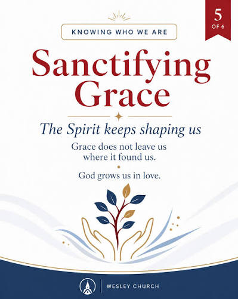
Sanctifying Grace: Living Out Love
Sanctification represents the final form of grace in John Wesley’s theology. Our journey began with prevenient grace, where God’s love is extended to everyone before we even respond. We then receive justifying grace, which occurs when we acknowledge God’s claim on our lives. Both prevenient and justifying grace are fundamental steps in restoring our relationship with God. However, many people struggle to embrace the final step—sanctification.
To put it simply, sanctification means actively practicing the love for our neighbors that Jesus commands. This is where the peace and joy promised in the Gospels are truly experienced. It is important to understand that sanctification is not the same as perfection. We remain human and are always in need of God’s forgiving grace. Nonetheless, sanctification involves continually striving to become a better version of ourselves. While salvation comes when we dedicate our lives to God, the deepest joy Jesus promises is realized when we serve others, following His example.
I Peter, am an apostle on assignment by Jesus, the Messiah, writing to exiles scattered to the four winds. Not one is missing, not one forgotten. God the Father has his eye on each of you and has determined by the work of the Spirit to keep you obedient through the sacrifice of Jesus. May everything good from God be yours!
Sanctifying Grace: Living Out Love
Sanctification represents the final form of grace in John Wesley’s theology. Our journey began with prevenient grace, where God’s love is extended to everyone before we even respond. We then receive justifying grace, which occurs when we acknowledge God’s claim on our lives. Both prevenient and justifying grace are fundamental steps in restoring our relationship with God. However, many people struggle to embrace the final step—sanctification.
To put it simply, sanctification means actively practicing the love for our neighbors that Jesus commands. This is where the peace and joy promised in the Gospels are truly experienced. It is important to understand that sanctification is not the same as perfection. We remain human and are always in need of God’s forgiving grace. Nonetheless, sanctification involves continually striving to become a better version of ourselves. While salvation comes when we dedicate our lives to God, the deepest joy Jesus promises is realized when we serve others, following His example.

Ephesians 2:4 – 5
But because of his great love for us, God, who is rich in mercy, made us alive with Christ even when we were dead in transgressions—it is by grace you have been saved.
Exploring Wesleyan Grace: Prevenient, Justifying, and Sanctifying Grace
In Tuesday’s devotional, I referenced John Wesley’s belief in prevenient grace—the grace that affirms God’s love for all as first and always. This means that God chooses to love us unconditionally. Prevenient grace is the assurance that God’s love is extended to everyone, without requirement or condition, and is freely given before we ever respond.
Today, we revisit what Wesley describes as Justifying Grace. This refers to the moment when we fully acknowledge and accept God’s call in our lives. It is the point at which we recognize God for the love that God is and choose to respond.
At this moment, we realize that we are called to live a life that is distinct from the rest of the world. We learn to love God in return for all that God has freely given us. This marks the beginning of the first and greatest commandment: to love God with all our heart, soul, and mind. The decision to love God is a choice made freely, but once it is made, it transforms our outlook on life forever.
On Tuesday, we will explore the third form of grace Wesley discusses—sanctification. Through prevenient and justifying grace, we are drawn to become a new creation, inspired by God’s love.
But because of his great love for us, God, who is rich in mercy, made us alive with Christ even when we were dead in transgressions—it is by grace you have been saved.
Exploring Wesleyan Grace: Prevenient, Justifying, and Sanctifying Grace
In Tuesday’s devotional, I referenced John Wesley’s belief in prevenient grace—the grace that affirms God’s love for all as first and always. This means that God chooses to love us unconditionally. Prevenient grace is the assurance that God’s love is extended to everyone, without requirement or condition, and is freely given before we ever respond.
Today, we revisit what Wesley describes as Justifying Grace. This refers to the moment when we fully acknowledge and accept God’s call in our lives. It is the point at which we recognize God for the love that God is and choose to respond.
At this moment, we realize that we are called to live a life that is distinct from the rest of the world. We learn to love God in return for all that God has freely given us. This marks the beginning of the first and greatest commandment: to love God with all our heart, soul, and mind. The decision to love God is a choice made freely, but once it is made, it transforms our outlook on life forever.
On Tuesday, we will explore the third form of grace Wesley discusses—sanctification. Through prevenient and justifying grace, we are drawn to become a new creation, inspired by God’s love.
Titus 2:11 (The Message)
God’s readiness to give and forgive is now public. Salvation’s available for everyone!
God’s Unconditional Love and Our Calling as Disciples
John Wesley emphasizes a profound truth that is essential for us to remember: God loves all of creation. This love extends to everyone and everything, without exception. There are no requirements or preconditions that must be fulfilled to receive God’s love; it is freely given to all.
As disciples of Christ, we are called to mirror God’s love in the world. This means loving our neighbors with the same prevenient love that God offers us—love that is genuine, unconditional, and freely given. Our love for others should reflect the grace God shows to each of us.
Jesus teaches us to love and pray for our enemies. By embodying such love and grace, we open ourselves to experiencing God’s own love and grace. Only through this genuine and unconditional love can we fully understand and share in the divine compassion that God offers.
God’s readiness to give and forgive is now public. Salvation’s available for everyone!
God’s Unconditional Love and Our Calling as Disciples
John Wesley emphasizes a profound truth that is essential for us to remember: God loves all of creation. This love extends to everyone and everything, without exception. There are no requirements or preconditions that must be fulfilled to receive God’s love; it is freely given to all.
As disciples of Christ, we are called to mirror God’s love in the world. This means loving our neighbors with the same prevenient love that God offers us—love that is genuine, unconditional, and freely given. Our love for others should reflect the grace God shows to each of us.
Jesus teaches us to love and pray for our enemies. By embodying such love and grace, we open ourselves to experiencing God’s own love and grace. Only through this genuine and unconditional love can we fully understand and share in the divine compassion that God offers.

Proverbs 20:7
“A righteous person acts with integrity; his children who come after him will be happy.”
Modeling Integrity and Compassion in Parenting
Continuing with the Father’s Day theme, it is important to recognize that teaching our children about integrity involves more than just speaking about it. Our actions must consistently reflect the values we wish to instill. By aligning our words and deeds, we create an environment that nurtures honor and truthfulness, preparing our children to become adults who value these principles.
Reflecting on my own experience, I am reminded of how my father modeled compassion and grace throughout his life. He always managed to do the right thing and ensured it was done in the right way. This example played a crucial role in shaping the person I have become. As I raise my own children, I strive to follow his lead, loving God by showing love and respect to all others.
“A righteous person acts with integrity; his children who come after him will be happy.”
Modeling Integrity and Compassion in Parenting
Continuing with the Father’s Day theme, it is important to recognize that teaching our children about integrity involves more than just speaking about it. Our actions must consistently reflect the values we wish to instill. By aligning our words and deeds, we create an environment that nurtures honor and truthfulness, preparing our children to become adults who value these principles.
Reflecting on my own experience, I am reminded of how my father modeled compassion and grace throughout his life. He always managed to do the right thing and ensured it was done in the right way. This example played a crucial role in shaping the person I have become. As I raise my own children, I strive to follow his lead, loving God by showing love and respect to all others.

𝐄𝐩𝐡𝐞𝐬𝐢𝐚𝐧𝐬 𝟔:𝟒
𝐅𝐚𝐭𝐡𝐞𝐫𝐬, 𝐝𝐨 𝐧𝐨𝐭 𝐩𝐫𝐨𝐯𝐨𝐤𝐞 𝐲𝐨𝐮𝐫 𝐜𝐡𝐢𝐥𝐝𝐫𝐞𝐧 𝐭𝐨 𝐚𝐧𝐠𝐞𝐫, 𝐛𝐮𝐭 𝐛𝐫𝐢𝐧𝐠 𝐭𝐡𝐞𝐦 𝐮𝐩 𝐢𝐧 𝐭𝐡𝐞 𝐝𝐢𝐬𝐜𝐢𝐩𝐥𝐢𝐧𝐞 𝐚𝐧𝐝 𝐢𝐧𝐬𝐭𝐫𝐮𝐜𝐭𝐢𝐨𝐧 𝐨𝐟 𝐭𝐡𝐞 𝐋𝐨𝐫𝐝.
Reflections on Parenting and God’s Guidance
As we approach Father’s Day, I am reminded of the significant challenges parents face today. The world is filled with many pitfalls that can lead our children away from God’s vision of hope, love, and peace for everyone. However, instead of dwelling on the negative influences that seek to draw us into darkness, let us turn our attention to the goodness that God has placed in this world. By focusing on what is positive and God-given, we can guide our children toward the light and encouragement that comes from faith.
The scripture chosen for today begins with the instruction: “do not provoke.” When any of us make mistakes, it is difficult to admit our faults, and it can be even more challenging when others continuously point out our shortcomings. This is why it is important to make a clear distinction between discipline and punishment. Punishment focuses on the mistake that was made and the consequences that follow. While acknowledging errors and consequences is necessary, if we stop there, the opportunity for positive growth is lost.
Instead, we should use discipline as a form of instruction. Through discipline, a young person can learn from their errors and gain the tools and understanding needed to avoid making similar mistakes in the future. Discipline rooted in love and guidance encourages growth and transformation, rather than resentment or shame.
True learning never happens without mistakes. Even Jesus understood this as he taught his disciples, and the Spirit of God continues to work in each of us in this way today. Recognizing the inevitability of mistakes allows us to lead with grace and forgiveness. God’s grace and forgiveness are the foundation for how we should guide all of God’s children, helping them move toward the light and love of God. By modeling forgiveness and grace, we foster an environment where growth, healing, and deepened faith are possible for everyone.
𝐅𝐚𝐭𝐡𝐞𝐫𝐬, 𝐝𝐨 𝐧𝐨𝐭 𝐩𝐫𝐨𝐯𝐨𝐤𝐞 𝐲𝐨𝐮𝐫 𝐜𝐡𝐢𝐥𝐝𝐫𝐞𝐧 𝐭𝐨 𝐚𝐧𝐠𝐞𝐫, 𝐛𝐮𝐭 𝐛𝐫𝐢𝐧𝐠 𝐭𝐡𝐞𝐦 𝐮𝐩 𝐢𝐧 𝐭𝐡𝐞 𝐝𝐢𝐬𝐜𝐢𝐩𝐥𝐢𝐧𝐞 𝐚𝐧𝐝 𝐢𝐧𝐬𝐭𝐫𝐮𝐜𝐭𝐢𝐨𝐧 𝐨𝐟 𝐭𝐡𝐞 𝐋𝐨𝐫𝐝.
Reflections on Parenting and God’s Guidance
As we approach Father’s Day, I am reminded of the significant challenges parents face today. The world is filled with many pitfalls that can lead our children away from God’s vision of hope, love, and peace for everyone. However, instead of dwelling on the negative influences that seek to draw us into darkness, let us turn our attention to the goodness that God has placed in this world. By focusing on what is positive and God-given, we can guide our children toward the light and encouragement that comes from faith.
The scripture chosen for today begins with the instruction: “do not provoke.” When any of us make mistakes, it is difficult to admit our faults, and it can be even more challenging when others continuously point out our shortcomings. This is why it is important to make a clear distinction between discipline and punishment. Punishment focuses on the mistake that was made and the consequences that follow. While acknowledging errors and consequences is necessary, if we stop there, the opportunity for positive growth is lost.
Instead, we should use discipline as a form of instruction. Through discipline, a young person can learn from their errors and gain the tools and understanding needed to avoid making similar mistakes in the future. Discipline rooted in love and guidance encourages growth and transformation, rather than resentment or shame.
True learning never happens without mistakes. Even Jesus understood this as he taught his disciples, and the Spirit of God continues to work in each of us in this way today. Recognizing the inevitability of mistakes allows us to lead with grace and forgiveness. God’s grace and forgiveness are the foundation for how we should guide all of God’s children, helping them move toward the light and love of God. By modeling forgiveness and grace, we foster an environment where growth, healing, and deepened faith are possible for everyone.
