

Psalm 115:5 (ESV)
For you have been called to live in freedom, my brothers and sisters. But don’t use your freedom to satisfy your sinful nature. Instead, use your freedom to serve one another in love.
True Freedom and Christian Responsibility
As we celebrate our country’s 250th birthday, it is essential to reflect on the source of true freedom. All people are created by God and, as a result, are inherently worthy of respect and dignity. This promise is assured by God through Jesus Christ. Throughout the Gospels and continuing through the rest of the New Testament, God’s plan of loving salvation extends to both Jew and gentile, affirming that no person is excluded from God’s justifying grace.
Let us, as Christians, remember that we are commanded to love our neighbors. Importantly, our neighbor is not limited only to those who agree with us. The call to love extends to everyone, regardless of differences. In living out this command, we discover the Fruit of the Spirit.
As we nurture qualities such as love, joy, peace, patience, kindness, goodness, faithfulness, gentleness, and self-control, we grow into the individuals and community that God created us to be. Let us strive every day, through God’s love, to become more perfect followers of Christ.
For you have been called to live in freedom, my brothers and sisters. But don’t use your freedom to satisfy your sinful nature. Instead, use your freedom to serve one another in love.
True Freedom and Christian Responsibility
As we celebrate our country’s 250th birthday, it is essential to reflect on the source of true freedom. All people are created by God and, as a result, are inherently worthy of respect and dignity. This promise is assured by God through Jesus Christ. Throughout the Gospels and continuing through the rest of the New Testament, God’s plan of loving salvation extends to both Jew and gentile, affirming that no person is excluded from God’s justifying grace.
Let us, as Christians, remember that we are commanded to love our neighbors. Importantly, our neighbor is not limited only to those who agree with us. The call to love extends to everyone, regardless of differences. In living out this command, we discover the Fruit of the Spirit.
As we nurture qualities such as love, joy, peace, patience, kindness, goodness, faithfulness, gentleness, and self-control, we grow into the individuals and community that God created us to be. Let us strive every day, through God’s love, to become more perfect followers of Christ.
Matthew 25:35 – 40
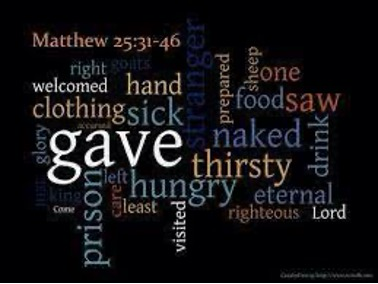
For I was hungry and you gave me something to eat, I was thirsty and you gave me something to drink, I was a stranger and you invited me in, I needed clothes and you clothed me, I was sick and you looked after me, I was in prison and you came to visit me.’
Then the righteous will answer him, 'Lord when did we see you hungry and feed you, or thirsty and give you something to drink? When did we see you a stranger and invite you in, or needing clothes and clothe you? When did we see you sick or in prison and go to visit you?
The King will reply, 'Truly I tell you, whatever you did for one of the least of these brothers and sisters of mine, you did for me.'
Matthew 25 contains one of my favorite passages, often referred to as "The Sheep and the Goats." In this section, Jesus presents a clear message about how we are to treat those who are marginalized in society. He emphasizes that serving the needs of others is central to living out our faith.
What stands out most is that the sheep described in this parable served God by caring for others without seeking recognition or realizing they were doing anything extraordinary. Their actions were motivated not by a desire for praise, but by a genuine commitment to do what was right and necessary. This is the standard for all who profess Jesus as their master: to serve others simply because it is the calling of Christ.
Let us strive to live our lives in such a way that, when we stand before the Lord in judgement, we will be welcomed into God's presence. This invitation comes because we have served God faithfully through meeting the needs of others, embodying the spirit of Christ in our actions every day.
For I was hungry and you gave me something to eat, I was thirsty and you gave me something to drink, I was a stranger and you invited me in, I needed clothes and you clothed me, I was sick and you looked after me, I was in prison and you came to visit me.’
Then the righteous will answer him, 'Lord when did we see you hungry and feed you, or thirsty and give you something to drink? When did we see you a stranger and invite you in, or needing clothes and clothe you? When did we see you sick or in prison and go to visit you?
The King will reply, 'Truly I tell you, whatever you did for one of the least of these brothers and sisters of mine, you did for me.'
Matthew 25 contains one of my favorite passages, often referred to as "The Sheep and the Goats." In this section, Jesus presents a clear message about how we are to treat those who are marginalized in society. He emphasizes that serving the needs of others is central to living out our faith.
What stands out most is that the sheep described in this parable served God by caring for others without seeking recognition or realizing they were doing anything extraordinary. Their actions were motivated not by a desire for praise, but by a genuine commitment to do what was right and necessary. This is the standard for all who profess Jesus as their master: to serve others simply because it is the calling of Christ.
Let us strive to live our lives in such a way that, when we stand before the Lord in judgement, we will be welcomed into God's presence. This invitation comes because we have served God faithfully through meeting the needs of others, embodying the spirit of Christ in our actions every day.

Philippians 2:3
Do nothing out of selfish ambition or vain conceit. Rather, in humility value others above yourselves,
The evil present in our world encourages us to embrace greed and selfishness. Society often promotes the belief that we must prioritize our own needs above all else, leaving little room to genuinely care for others. This mindset suggests that the struggles and needs of others are theirs alone to manage, and that our main concern should be our own advancement. In such an environment, true joy is elusive, as life becomes an endless pursuit of personal goals and achievements. The constant glorification of our own accomplishments, even when it comes at the expense of others, only reinforces this cycle of self-importance.
Jesus taught a radically different message, which Paul continued to spread. The good news was not about self-promotion, but about becoming servants first. Jesus exemplified this through His life, and ultimately, through His death on the cross. We are called to embrace humility, putting the needs of others before our own. It is in this act of valuing others above ourselves that we truly live into our purpose and reflect what we were created to be.
Do nothing out of selfish ambition or vain conceit. Rather, in humility value others above yourselves,
The evil present in our world encourages us to embrace greed and selfishness. Society often promotes the belief that we must prioritize our own needs above all else, leaving little room to genuinely care for others. This mindset suggests that the struggles and needs of others are theirs alone to manage, and that our main concern should be our own advancement. In such an environment, true joy is elusive, as life becomes an endless pursuit of personal goals and achievements. The constant glorification of our own accomplishments, even when it comes at the expense of others, only reinforces this cycle of self-importance.
Jesus taught a radically different message, which Paul continued to spread. The good news was not about self-promotion, but about becoming servants first. Jesus exemplified this through His life, and ultimately, through His death on the cross. We are called to embrace humility, putting the needs of others before our own. It is in this act of valuing others above ourselves that we truly live into our purpose and reflect what we were created to be.
